In Hsinchu the other day, I popped into a traditional bakery across the road from the Du Chenghuang Temple. I'd visited this part of the city four or five times before, but never before had I noticed that the tall building that houses the bakery (and a cinema, incidentally) bears Chinese characters which mean 'hundred-year-old shop.'
Intrigued, I went inside. It's the
flagship store of Hsin Fu Jean (新復珍, 6 Beimen Street;
open: 08.00-22.30 daily), a maker of sweet and savoury delicacies that's been in business
since 1898. The staff are friendly, and generous with free samples. Their signature product is a flaky pastry called Chu-chan Cake (竹塹餅), which happens to be the old name of Hsinchu. (Zhuqian
would be a more standard spelling than Chu-Chan; back then, most people spoke Holo, and would have pronounced it Tek-kham.) The filling is mostly ground
pork, but it's the zesty green onions that make this baked delight especially
memorable. The company also sells walnut cake, mochi, and rice puffs.
When I got home and looked more carefully at the leaflets the staff had given me, I noticed something odd. The business was described as having been founded in 1898, the 24th year of the Emperor Guangxu (光緒) of the Qing Dynasty. Yet at that time Taiwan was part of the Japanese Empire; it was the 31st year of the reign of Emperor Meiji (明治天皇). Perhaps the family which founded the bakery was especially loyal to the Qing, or had reasons to despise the Japanese...
Showing posts with label Hsinchu. Show all posts
Wednesday, August 30, 2017
Thursday, August 21, 2014
The keymaker of Hsinchu
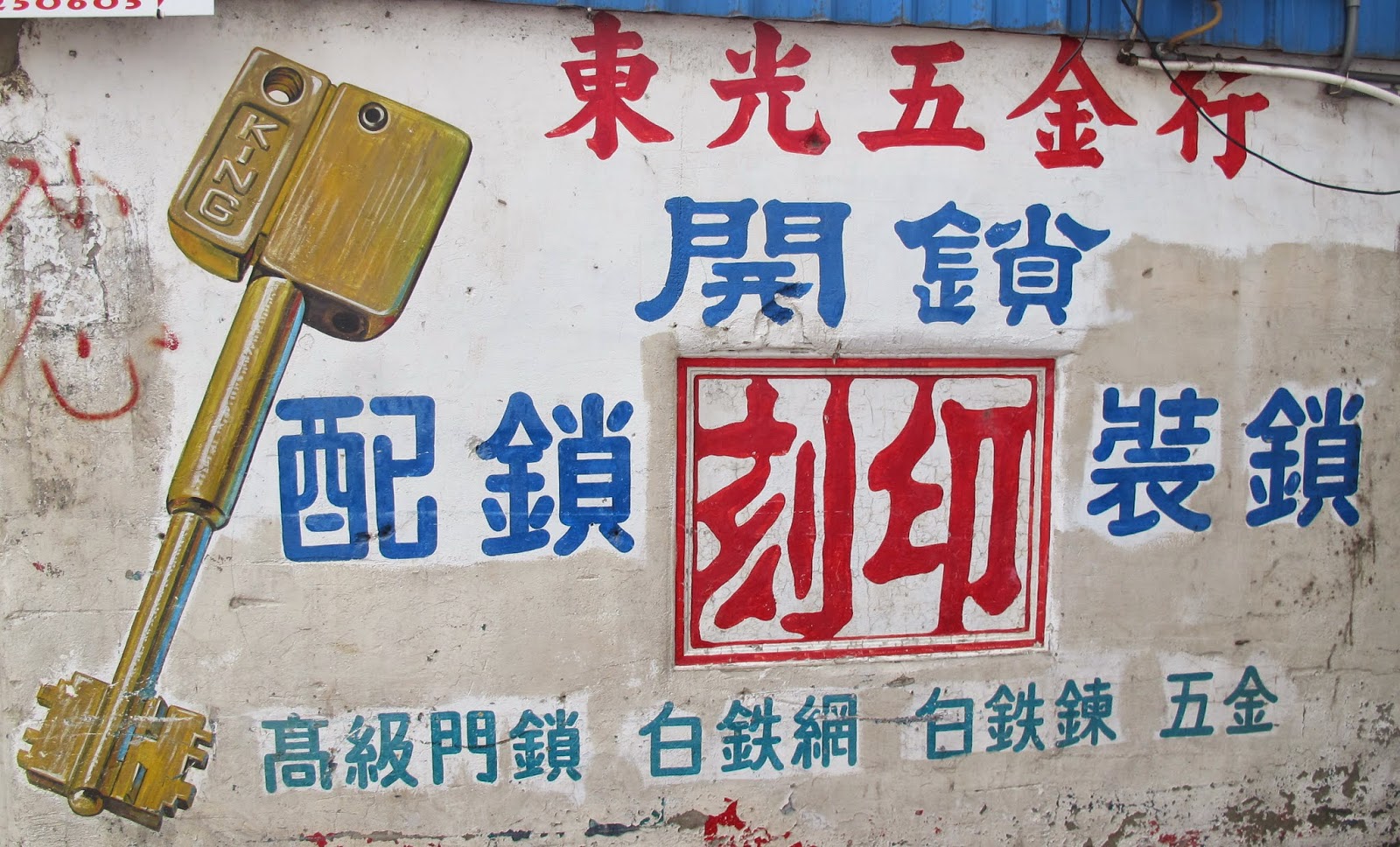
Spotted earlier this year in a side street in Hsinchu's city centre: A hand-painted ad for a maker of keys, chops and similar items. Hsinchu is usually associated with high-tech industries but it's unusually rich in relics of the Qing period as well as the Japanese colonial era.
Monday, November 26, 2012
Fresh Facts VI: Taiwan's first railway
The
Sino-French War of 1884-85 underscored Taiwan's vulnerability to
foreign invasion, and was a factor leading to the construction of the
Keelung-Hsinchu railroad. Work on the railway started in 1886 but it
wasn't until early 1892 that a short stretch (about 45km) was open
for traffic.
The project was delayed because Qing officials ignored or overruled the European engineers hired to supervise construction; requests to divert the line for reasons of fengshui had to be dealt with; and many of the pegs marking the proposed route were removed by locals who used them for firewood.
Tuesday, October 9, 2012
Two attractions in Zhubei
Zhubei City (竹北市) is a rapidly-growing part of Hsinchu County, much of the growth being driven by residential and commercial developments near Hsinchu HSR Station. A handful of old, single-storey homes have been preserved and turned into New Tile House (新瓦屋), also known as the Hakka Art Village. New Tile House is visually attractive (see this Chinese-language blog for good photos) but unless you come on a weekend, when there's live traditional music, it's not worth going out of your way for. Bus #1782 from the HSR station stops outside New Tile House. If you want to walk, it'll take you around 20 minutes.
If you're in the neighbourhood and want a soft drink, a beer or English-language conversation, drop by the intriguingly-named Titty Tea, which is less than 100m away. In the evenings there's often live music or comedy.
Labels:
food,
Hakka,
Hsinchu,
things that aren't in the guidebook
Sunday, November 7, 2010
Books: Chingchuan Story
You're unlikely to find Chingchuan Story outside Taiwan, and even on the island it isn't widely available. This is a pity, because it's an easy-to-read, engaging portrait of life in an aboriginal village.The author, Barry Martinson, is a Jesuit missionary who has lived and worked in and around Chingchuan (nowadays often spelled Qingquan) in Hsinchu County since 1976. His writing style is unadorned and his anecdotes are arranged in short chapters. These cover his efforts to preserve Atayal culture as well as promote Catholicism. He doesn't shy away from unsavoury aspects of indigenous life (such as alcoholism), nor is he afraid of recalling episodes when he made a fool of himself.
One of the most memorable chapters deals with hunting and traditional cuisine. In it, he admits he has never been able to eat flying squirrel (now a protected species):
"Perhaps this has something to do with its preparation. The flying squirrel is seldom cooked. It is salted and placed in cooked rice for several days. Then it is eaten, by hand, straight from the soggy rice."
Later in the same chapter he relates another rodent-eating experience:
"I remember when Youmin and his family were cooking large field mice by placing them over the fire for a few minutes until their hair was charred off. Youmin broke off the feet and tails and tossed them to his little children to gnaw on. Then he slit open a mouse intestine and squeezed the contents onto a spoon [saying the Atayal regard it as a traditional medicine]. Reluctantly I tried it. It was over two weeks before I could get that taste out of my mouth."
For details of how to obtain this book or others by the same author, go to the publisher's website.
To read Martinson's article about Chingchuan's most famous former resident, the warlord-general Zhang Xueliang (Chang Hsueh-liang), go here.
Labels:
aborigines,
books,
food,
Hsinchu,
mountains,
things that aren't in the guidebook
Sunday, December 6, 2009
Spelling of stations and towns according to Taiwan Railways
The Taiwan Railways Administration, the central government agency that runs Taiwan's conventional rail network, has clarified which station names are to be spelled according to hanyu pinyin, now Taiwan's official system for rendering Chinese words into the Latin alphabet, and which are to continue to be known by their old spellings.
The rationale, it seems, is that to change the spelling of Taipei, Kaohsiung and other places well known outside Taiwan would confuse non-Taiwanese. Ten cities fall into this category. Here they are, with the spelling in parantheses is hanyu pinyin:
From north to south: Keelung (Jilong); Taipei (Taibei); Hsinchu (Xinzhu); Taichung (Taizhong); Changhua(Zhanghua); Chiayi (Jiayi); Kaohsiung (Gaoxiong); Pingtung (Pingdong). On the east coast: Hualien (Hualian); Taitung (Taidong).
Of course, it's by no means certain that other government agencies, such as the Freeway Bureau, which administers Taiwan's motorways, will do the same. When driving, be prepared to see Taizhong, Pingdong etc.
2011 UPDATE
According to reports in the Chinese-language media, such as this one, the government has decided that hanyu pinyin will not be universally applied to smaller towns. The town previously known as Lukang (鹿港) will retain that old spelling - rather than Lugang - while Danshui (淡水) will officially be Tamsui, a rendering of the place name as its pronounced in Taiwanese.
The rationale, it seems, is that to change the spelling of Taipei, Kaohsiung and other places well known outside Taiwan would confuse non-Taiwanese. Ten cities fall into this category. Here they are, with the spelling in parantheses is hanyu pinyin:
From north to south: Keelung (Jilong); Taipei (Taibei); Hsinchu (Xinzhu); Taichung (Taizhong); Changhua(Zhanghua); Chiayi (Jiayi); Kaohsiung (Gaoxiong); Pingtung (Pingdong). On the east coast: Hualien (Hualian); Taitung (Taidong).
Of course, it's by no means certain that other government agencies, such as the Freeway Bureau, which administers Taiwan's motorways, will do the same. When driving, be prepared to see Taizhong, Pingdong etc.
2011 UPDATE
According to reports in the Chinese-language media, such as this one, the government has decided that hanyu pinyin will not be universally applied to smaller towns. The town previously known as Lukang (鹿港) will retain that old spelling - rather than Lugang - while Danshui (淡水) will officially be Tamsui, a rendering of the place name as its pronounced in Taiwanese.
Monday, August 3, 2009
Festivals in Taiwan
This article I wrote for the government's Taiwan Review looks at three of the island's major festivals: the Songjiang Battle Array in Kaohsiung County, Hsinchu City's Glass Art Street Carnival and the Mid-Summer Ghost Festival in Keelung.
Wednesday, February 18, 2009
Fourteen days, ten counties and cities
Since getting back to Taiwan two weeks ago, after spending the Lunar New Year in England, work on the guidebook has been both helped and hindered by a temporary job - working as a "commissioner" (essentially being a judge) for the Research, Development & Evaluation Commission's English Emblem Promotion Project.
The goal of this project is to enhance the bilingual (English & Chinese) environment in places foreigners might need or wish to go. My team visited hospitals and healthcare-product stores, a field which interests me because of the worldwide growth of medical tourism.
So, in 14 days I've been to Taipei City, Taoyuan County, Hsinchu City, Taichung City, Taichung County, Changhua County, Chiayi County, Chiayi City, Kaohsiung City and, just yesterday, Hualien City. By plane, train (TRA and HSR), van and taxi...
The goal of this project is to enhance the bilingual (English & Chinese) environment in places foreigners might need or wish to go. My team visited hospitals and healthcare-product stores, a field which interests me because of the worldwide growth of medical tourism.
So, in 14 days I've been to Taipei City, Taoyuan County, Hsinchu City, Taichung City, Taichung County, Changhua County, Chiayi County, Chiayi City, Kaohsiung City and, just yesterday, Hualien City. By plane, train (TRA and HSR), van and taxi...
Subscribe to:
Posts (Atom)