Showing posts with label photos. Show all posts

Thursday, April 20, 2017

Yuli-Fuli Bikeway

Yuli (花蓮縣玉里鎮) in the southern part of Hualien County has long been a crossroads. It's here that 19th-century migrants from west Taiwan via the Batongguan Ancient Trail emerged from the Central Mountain Range. Some of these pioneers proceeded north or south within the East Rift Valley. Others continued eastward across the Xiuguluan River and Coastal Mountain Range to the Pacific coast, taking a route similar to what's now the Yuchang Highway (Highway 30).
Like much of the East Rift Valley National Scenic Area, Yuli is thinly populated and there’s never a lot of traffic. Cycling is therefore a fun (as well as eco-friendly) way of exploring the township, which sprawls over 252 square kilometers. The authorities have done their bit to make the area attractive to pedal-powered tourists by creating the Yufu Bikeway (玉富自行車道), a 9.8km-long bike path that starts in central Yuli. 
The history of the bikeway is, in fact, tied to the the history of the railway. In recent years, Taiwan’s government has upgraded and electrified the railroad in the east. In the process, the stretch immediately south of central Yuli was straightened. Instead of crossing the Xiuguluan River, it now takes a more direct route toward Taitung. One reason for this is that the rock-strewn bed of the Xiuguluan River - which empties into the Pacific 25km away as the crow flies - conceals an important geological boundary. 
The land east of the waterway, including the Coastal Mountain Range, is part of the Philippine Sea Plate. Everything to the west is part of the Eurasian Plate. East Taiwan’s hot springs and frequent tremors - not to mention much of its rugged beauty - can be attributed to the ongoing collision between these plates. 
Each year, tectonic forces drive a bit more of the Eurasian Plate under the Philippine Sea Plate. As a consequence, the Coastal Mountain Range grows a little higher. But this tectonic mismatch causes problems for humanity. The road bridge that crosses the river has to be fixed every three to five years. A tremendous inconvenience, of course, yet an interesting spot to stop, learn a bit about natural processes, and take a team photo!
As even minor distortion of the tracks could cause the derailment of a speeding locomotive, what used to be the railway bridge (and now serves as part of the bike path) had to be repaired and realigned approximately every two years. Enjoying the bikeway recently as guests of the scenic area, we barely noticed the gradient while pedaling across. But a little later, pausing for breath at the 3.2km marker and looking back at the bridge, the disparity was obvious. 
Antong (安通) Cycling Station is a former railway station supposedly repurposed for the benefit of bikers, but at the time of our visit there were no food, drink or repair services - not even a vending machine. Local folk make good use of the bikeway, and not just to reach their fields. One lady we came across was laying out Hakka-style dried pickled mustard greens (meigan cai, written 梅干菜 or 霉乾菜, shown above).
The bike path ends at Dongli (東里) Old Station, where you can get a cup of coffee, snacks and postcards. For cyclists eager to explore further, it's easy enough to continue southward on Highway 9 (the main north-south road in the East Rift Valley), although the traffic is sometimes quite heavy. We turned around so we could take in a few sights in the town center before boarding our trains home. One of these we would never have found but for the help of the local hotelier accompanying us: A section of creek at the corner of Heping Road and Minguo Road Section 1 where local housewives and grandmothers still hand-wash clothes in the traditional manner. 
In the parkland on the corner of Minquan Street and Zhonghua Road, there's a green-and-white bus bearing the logo of Taiwan’s postal service. This vehicle formerly provided Taiwan's only mobile postal (and post-office banking) services, regularly touring the township's remoter villages. A stone's throw away, local artists create and sell works at Pu-Shi Printing & Dyeing Art Workshop (璞石藝術館).
Upstairs, the emphasis is on stone art, created using tiny fragments of various stones, some of which are imported. Many of the works reflect indigenous themes:
This visit and blog post were sponsored by the East Rift Valley National Scenic Area Administration.


Tuesday, September 13, 2016

A nocturnal nature ramble

Inland of central Tainan, the hill country starts about 25km from the sea. Back in 2007, I wrote two articles about this region of mixed forest and bamboo groves for a local English-language newspaper. (See here and here. At that time the authorities decreed 新化 should be spelled Sinhua; they now prefer Xinhua.)


I’ve hiked through these woodlands dozens of times but, until last weekend, never at night. Meeting up a little later than planned with Richard Foster (an old friend and full-time birding guide) and Dane Harris (an American who’s led dozens of people on middle-of-the-night nature rambles), we entered the forest near Xinhua National Forest Arboretum (新化國家植物園). 

Within minutes of leaving our vehicle, we spotted in the canopy right above us a red giant flying squirrel (Petaurista petaurista, like the one pictured above). I was as surprised as I was delighted: I’ve glimpsed these creatures before, but never so close to a major urban area. From time to time, Dane also comes across Asian palm civets; we weren’t in luck. (Within a fortnight my luck changed for the better.) 
Dane’s true passion is snakes, and he’s as willing to hold them as a Pentecostal pastor in Appalachia. But rather than put his trust in a deity, he practices safe-handling techniques. These are critical, as one of the four serpentine species we encountered was the extremely venomous many-banded krait (Bungarus multicinctus). Our tally for the evening also included a red-banded snake (Dinodon rufozonatum), three common mock vipers (Psammodynastes pulverulentus papenfussi; a subspecies endemic to Taiwan pictured below) and one greater green snake (Cyclophiops major, shown above).

According to the excellent website Snakes of Taiwan: “the harmless, invertebrate-eating greater green snake is frequently mistaken for the Chinese tree viper [aka Stejneger's pit viper or Trimeresurus stejnegeri] and subsequently killed… [but] the differences are quite obvious at a closer glance: the Chinese tree viper has a triangular head, red eyes, a white stripe along both sides of the body, and a reddish-brown tail. The greater green snake has an oval head, black eyes, no stripes, and a green tail. Its scales are also much shinier than the matte, dull coloring of the Chinese tree viper.”  
Dane glimpsed but was unable to detain and show us a Taiwan habu (Protobothrops mucrosquamatus), a highly venomous snake alternatively known as a brown spotted pitviper. 

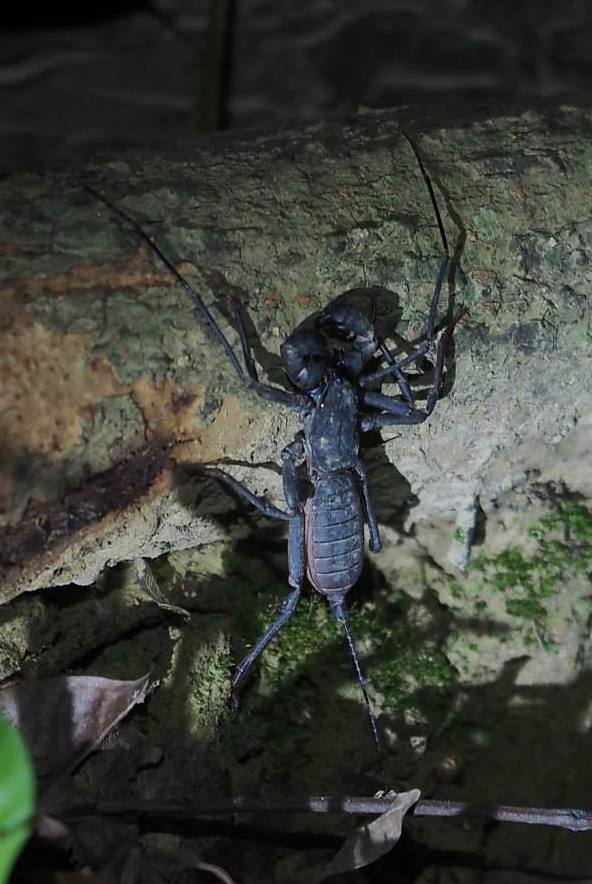
The understory near Xinhua is rich in insect life. We encountered dozens of grasshoppers representing at least seven species or subspecies, a single European mantis, lots of snails, a few slugs, large spiders and impressive centipedes. Dane pointed out a creature I’d never previously heard of: Thelyphonida, commonly known as a whip scorpion or vinegaroon (pictured below). These black  arachnids are typically five or six cm long, including tail. The name “vinegaroon” comes from their ability to squirt out a mildly noxious, vinegar-like substance when threatened. They feed on millipedes, cockroaches and crickets, and when once you’ve learned to recognise them, you’ll see them all over the forest.
Glowing mushrooms were another highlight. Of the world’s 75 species of luminous fungi, nine - including one only identified in 2013 - grow in Taiwan. 

Dane is happy to introduce Xinhua’s wildlife to visitors and expats based in other cities. These expeditions, which often last well into the early hours, are moderately strenuous. Good footwear is essential as you’ll likely go off-trail, especially if you hope to see bioluminescent mushrooms. You’ll also need your own transport to the trailhead, but Dane can lend powerful flashlights. He can be reached via daneharris@hotmail.com or through Facebook. The photos here are his; lots more can be found on his Facebook page.


Tuesday, January 12, 2016

The art of photographing gods - a Taiwan Temples podcast


Two friends and occasional collaborators, Robert Kelly and Rich J. Matheson, are working on a project called Taiwan Temples. Believing Taiwan's Buddhist/Taoist/folk shrines are worthy of UNESCO World Heritage status and worldwide acclaim - but haven't received any such recognition because of the island's political isolation - the two are assembling pictures, videos, audio- and mini-essays about what they describe as an "outstanding branch of southern Chinese architecture, and the dynamic folk culture that surrounds it."

They recently released their first podcast. It's about Wu Tai-pu, a wedding photographer who in his spare time takes portraits of god statues in temples across Taiwan. For this podcast he was interviewed in Mandarin by Rich J. Matheson, and I was pleased to help out by doing the English-language voice-over. To listen to this in-depth discussion, which ranges from getting permission to take photos to spirit writing and supernatural possession, go here.

The image above shows the roof of Fongtian Temple in Chiayi County's Xingang Township. These days, it's best known as the southernmost point on the annual Mazu pilgrimage which sets out from Dajia's Jenn Lann Temple each spring. 

Friday, December 11, 2015

Taiwan through the lens of Josh Ellis, Part 2

This is Part 2 of an interview with Josh Ellis, a Canadian photographer living in north Taiwan. (Part 1 is here.)

Do you do commercial photography?

Yes. I have to travel around the country getting shots for clients, which requires a bit of flexibility. Most of the people I do work for are overseas and probably don't understand the amount of travel involved in doing what I do for them. When I originally arrived in Taiwan, I started working for an English school and I'm still there part-time. They’re quite flexible with me and treat me quite well; they’re willing to accept that my workload will be considerably less than most of their other employees. I teach a few days per week for them and also help with training new employees. Teaching was always a means to an end, particularly when I needed a work permit. I'm now a permanent resident, so I can do pretty much whatever I want, work-wise. My friends often ask why I still bother to teach, but I like the flexibility my company gives me. Also, the income it brings stabilizes my fluctuating photography income.

Have you had any weird or unpleasant experiences when taking photos?

Generally speaking, Taiwan is a very photo-friendly country. Over the past five or so years DSLR cameras have become pretty common. A lot of people are trying their hand at photography and I find that the accessibility of so-called professional-level cameras tends to skew the line between amateur and professional; this is part of the reason why I don't like to use the terms very often. The amount of images floating around the internet really creates a lot of competition for working photographers, so you have to do your best to stand out from the crowd and only post your best work. That being said, Taiwanese people are generally pretty great when it comes to photography. When you do street photography it is all about the momentary relationship you create with a person. Sometimes you’ll find someone who doesn't want their photo taken but most of the time it is fine and people don't mind. 

In my decade of shooting here I’ve only been told not to take a photo of something twice. I remember each experience vividly because of the rarity of being told not to take a shot and the strangeness of the situations. The first time was a year or so ago on Shenkeng Old Street. I came across a store that had a bunch of cool-looking traditional hats and oddities on the storefront. What struck me about the place was how adamant the boss was about not wanting pictures to be taken. He had at least 10 different signs saying “No photos,” which I thought was quite extreme. I decided to take a photo out of spite since the boss was standing in front of me. The resulting photo [below] features a guy with an angry face, and it made an excellent street shot with what was happening in the background. 
More recently while I was shooting Zhinan Temple, near Maokong in Taipei. A temple volunteer took exception to me shooting a religious ceremony taking place and indicated quite rudely that I shouldn't be taking photos. She then proceeded to follow me around until I felt so uncomfortable I left. As a photographer you have to be considerate of people and know when something is okay and when it isn't. I do my best to be respectful and considerate of people in all aspects of life, so photography is just an extension of that. If anyone ever objects to what I do, then I will delete the shot and apologize. I think that is probably a general rule among most people who are fans of street photography – but for the most part Taiwanese people are very welcoming and don't mind having their pictures taken.

You live in Zhongli, which has something of bad reputation.

Before coming to Taiwan I didn't do much research. I had heard how beautiful Taiwan was when I was in China. The people there had talked about the country as a sort of Shangri-La they all wanted to visit but couldn't because of the political situation at the time. I thought that nowhere could be as bad as Beijing when it comes to pollution and weather, so when I decided to accept a position as a teacher I didn't really bother to check where it was. I noted that I'd be living close to the airport and a short bus or train ride to Taipei, but would also be close to the mountains and Hsinchu

After living in Zhongli [pictured below] for ten years, I can't say I have any complaints or that in my ignorance I made a terrible mistake. I have a love affair with the city, even though I know it has a bad reputation among expats. I think most of those opinions are unfounded. The way I see it is that I live in a city full of Hakka people, culture and food. I have a great respect for that culture and I think you'll see through my work that I've done a lot to promote Hakka culture and different tourist spots related to their history on the island. Zhongli isn't perfect – like any industrial city it does have its gloom, especially during winter. 
Living here for ten years means I've seen the city change and develop into much nicer, cleaner and greener place. I like the direction the city is taking. When the MRT line is completed, it’ll be another satellite city of Taipei and will attract people sick of the cost of living in the capital. People often ask why I don't move to Taipei, but I don't see why I'd leave where I am. Most of my work is done outside of Taipei and moving there would just require more travelling. Also, most landlords in the capital aren’t big fans of tenants who have pets. I have a Shetland Sheepdog that was saved from a shelter near here. My ancestry is 100% Scottish and one of the ways we celebrate our heritage is to always have a sheltie. My parents have one, my sister has one and when I found the opportunity to get one, I got one too.

Tuesday, December 8, 2015

Taiwan through the lens of Josh Ellis, Part 1

Josh Ellis, who grew up next to the ocean on Canada’s east coast, has been photographing Taiwan since 2005. He describes his website as a “showcase for what I do, but also a way of promoting Taiwan and helping educate people around the world about how amazing this country is.” This is Part I of an interview conducted by email in October and November 2015. 
Is it true you ended up studying Chinese by accident?

Yeah, when I got to university, I found I had to take a second-language credit in order to graduate. I decided to try my hand at Japanese. The class was full of young guys much more invested in learning the language than I was, so on the first day of class, when the dean asked some of us if we would be willing to consider taking another language to free up space, I decided to take Mandarin instead. That decision pretty much shaped what’s happened since. I graduated with dual degrees in International Development and Asian Studies; before graduation I did an internship which brought me to China to further develop my language skills in an immersion program at Peking University, and to work on a Canadian government sponsored development project.

Why did you move to Taiwan? 

After graduation, I spent a few months checking out the job market in Canada, but felt the itch to come back to Asia to improve my language skills and continue travelling. I saw an ad about teaching English in Taiwan, so decided to give it a try. I arrived in Taiwan in the summer of 2005, and I noticed almost right away that Taiwan was a lot different to China. I noticed how clean it was and how the people seemed to be quite similar to Canadians in terms of how they treated others. Some of these similarities are among the reasons I’ve stayed for over a decade. I love that I can be in a modern city with a population bigger than most Canadian cities, but still be so close to nature. Taiwan has spoiled me over these years and I have a hard time thinking what life would be like back home without all the conveniences of this beautiful country.

Were you already a keen photographer when you arrived?

I was always into photography when I was young but wasn’t really able to do anything serious about it. After arriving, like a lot of travellers I took pictures documenting everything I was doing, and all the things that were new to me, to show friends and family back home. After about a month of living here I decided to upgrade and buy my first DSLR. Since then, everything I’ve done has been somewhat photography-related. Photography has been a very important facet of my experiences here.
I hope that when people see photos I’ve shot and how I frame them, they’re able to learn something not only from the photo, but from the information I provide with them. It’s great to hear from Taiwanese friends that I’ve shot something they didn’t even know existed, or that they’d never really imagined it would look as cool as it does in one of my photos. I think when you’re a foreign photographer in any country you tend to look at things differently to the locals, and see what they might miss or think isn’t special.

Many photographers adore Taiwan’s temple culture. Are you one of them?

Absolutely. I’ve spent a lot of time exploring temples all over the nation and trying to learn as much about them as I can. I love taking shots which not only show off the beautiful architecture, but also the amazing details you find inside. 

Taiwan also offers a lot of opportunity for taking beautiful landscape shots. I’m often lugging heavy camera gear up some of Taiwan’s highest mountains and taking shots of the coastline, rivers and waterfalls. Taiwan may be a small country, but there are countless locations available to photographers to show off the beauty of the country. 

Apart from temples and natural landscape, what else appeals to you?

I’m also a big fan of street photography, which involves walking around and getting candid shots of people going about their everyday lives. I think not living Taipei means I have better opportunities to explore and take photos that tell the story of Taiwan’s people and their lives.  
I do a lot of research about the places I visit, and I’m still trying to gauge what my audience is most interested in. My posts about the Qingshui Cliffs [pictured above] and Mukumugi Gorge in Hualien generated quite a lot of buzz, but then so did my post about the controversial Pigs of God ritual; this might the only post where I criticize Taiwan. I posted a quick article about a local restaurant that I thought would be nostalgic for some of my ex-coworkers who’ve since left Taiwan; it ended up going viral with hundreds of thousands of hits since I posted it, something I never would have imagined. Earlier this year I did a project where I visited several of Taiwan’s biggest night markets to shoot street-photography-style portraits of the people working there and explain a bit about what they do. This project has been quite popular. I’ve finished the shooting and hope to have the last four posts, about Miaokou Night Market in Keelung, posted before the end of the year.

I think I’m a very organized person, so I’ve a long list of places I need to get to over a certain period of time. I recently hiked up to a peak that isn’t very well known, Yuanzui Mountain in Daxueshan National Forest Recreation Area. From the peak there’s an amazing 360-degree view of Taiwan’s mountains. The location is perfect for the kind of work I do, but unfortunately as I was nearing the peak the weather took a turn for the worse. Everything disappeared in a cloud of mist, which means I need to make another trip in the near future. Apart from mountains, I’ll be shooting some upcoming temple festivals, Taiwanese opera performances, and I’m hoping to get to Kinmen and Matsu in the near future.

Part 2 of the interview can be read here.


Sunday, April 26, 2015

The old logging village of Lintianshan

These images are displayed in Hualien County's Lintianshan (林田山), which between the 1920s and early 1970s was a centre of Taiwan's timber industry. According to this article, at one point over 2,000 people lived here. Now just a handful of households remain. Lintianshan itself is at the base of the mountains; the actual felling was done at higher elevations, reached by a network of narrow-guage railroads (see the pictures below) and cable links. In the photo above, notice the man on the right has a baby strapped to his back!
Industrial accidents were surely very common given the absence of helmets and harnesses, not to mention the precipices and unstable cliffs which characterize Taiwan's mountains.
To get an idea how far Lintianshan's logging railway penetrated into the interior, see maps 27 and 28 in the Central East Taiwan section of taiwanrailways.com.

Thursday, August 21, 2014

The keymaker of Hsinchu

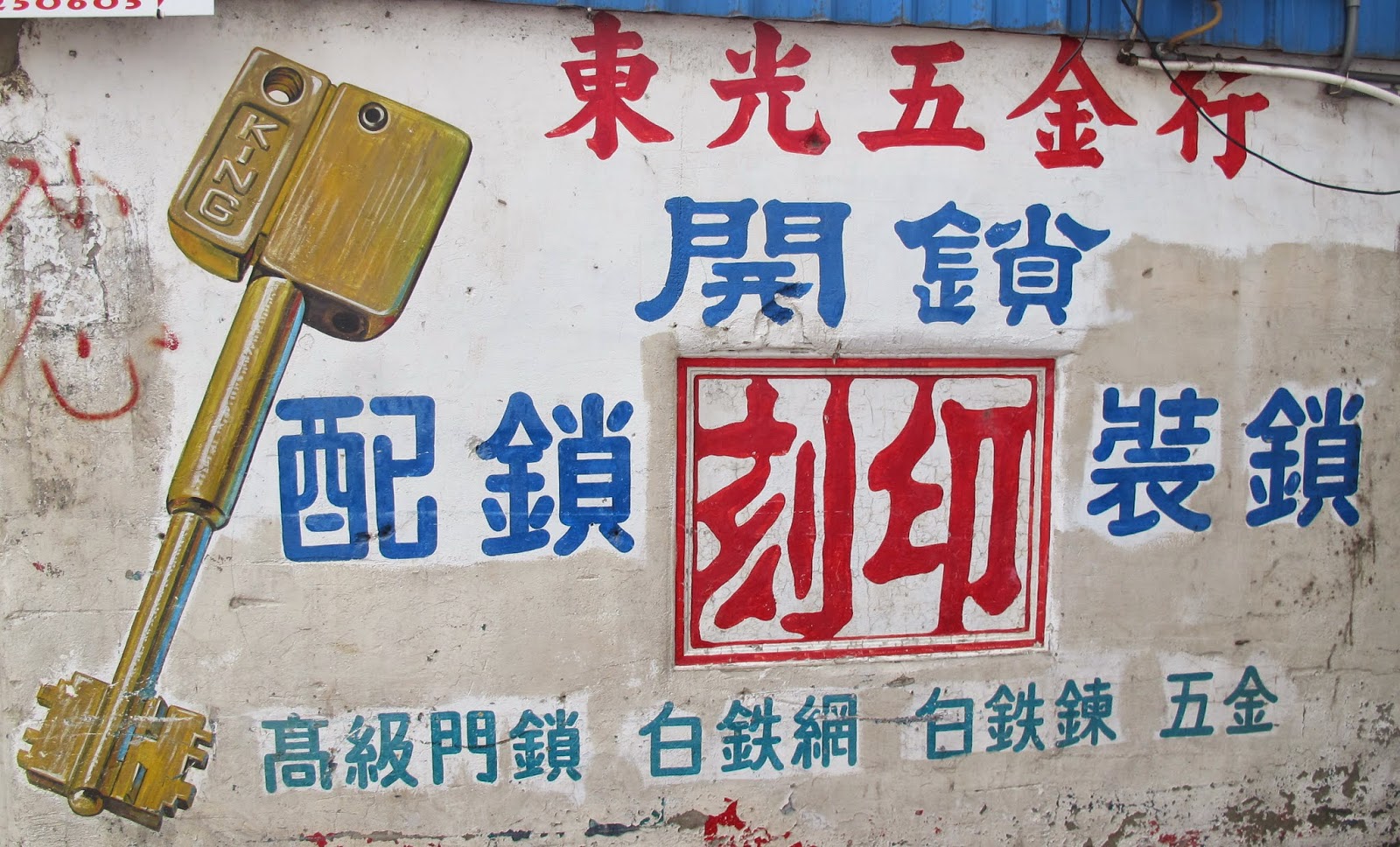
Spotted earlier this year in a side street in Hsinchu's city centre: A hand-painted ad for a maker of keys, chops and similar items. Hsinchu is usually associated with high-tech industries but it's unusually rich in relics of the Qing period as well as the Japanese colonial era.

Sunday, August 3, 2014

Budai Seafood Market

When updating my guidebook, I had to drop a few locations to make space for new attractions such as the Buddha Memorial Centre, and also so I could expand my coverage of, among other places, the East Rift Valley. One place I cut out is Budai Seafood Market (布袋漁市) in Chiayi County, pictured here.
It's still worth going to if you enjoy eating super-fresh seafood, as within the market there are around 40 restaurants, none of which are very expensive. Late morning to early afternoon is the best time to go; don't expect English to be spoken or English-language menus, but this isn't a problem as most eateries have picture menus and/or tanks from which you can select the creature(s) you want to enjoy.
Photographers take note: Even if you don't much like seafood, you may find the market worth visiting for visual reasons. The market is very easy to find, being on Zhongshan Road, the main road through the town to its port. Buses from Chiayi City and Xinying in Tainan stop within 20m.

Monday, February 10, 2014

Taroko Gorge in winter

There's no bad time of year to visit Taroko Gorge. On my most recent trip, it was misty and drizzled from time to time, but everyone enjoyed themselves immensely.
Being midweek, Swallow Grotto wasn't crowded with tourists.
But nor were there many swallows...

Friday, December 6, 2013

Miaoli's Mingde Reservoir

A recent visit to Mingde Reservoir (明德水庫) in Miaoli County (苗栗縣) coincided with a spell of excellent weather. We stayed right by the water's edge, within walking distance of civilisation but still enjoying excellent views of the lake and nearby mountains. The dam here was built between 1966 and 1970 and is 35.5m high; the water area is around 170 hectares. The area is especially popular, and deservedly so, with long-distance cyclists who adore the combination of scenery, light traffic and moderate gradients.
Late autumn and early winter is silvergrass season in many parts of Taiwan. The grass itself is between one and two metres tall and often grows on riverbanks or beside ponds.
I posted another photo of the reservoir on Life of Taiwan's Facebook page.

Wednesday, October 9, 2013

Unveiling the second-edition cover

The cover of the second edition shows daylily pickers in Hualien County. I'm still updating the text; the book won't be out until spring next year.

Saturday, September 21, 2013

Taiwan, 55 years ago

Click on this link to see an online album of 278 photos, the majority of which were taken in Taiwan in 1957-58 by US serviceman Tom Jones. The images show the north coast, Taipei's streets (the capital was then a low-rise, relatively uncrowded city), funerals, temples and military personnel.

Monday, February 25, 2013

Photos and panoramas of Kaohsiung

This Kaohsiung City Government website has an engaging collection of photos and panoramas of attractions in the municipality, including aerial shots of Mount Banping, the very modern Da Dong Arts Center in Fengshan District and an oil-paper umbrella store in Meinong.

Just a few days ago, I was at this spot in Maolin, enjoying very similar views of the surrounding mountains and the post-Typhoon Morakot bridge.

Monday, November 19, 2012

Pan Li-shui's art

Taipei's Baoan Temple is one of my favorite places of worship because the interior artwork is superb. The 1995-2002 restoration of the shrine won an honourable mention in the 2003 UNESCO Asia-Pacific Heritage Awards for Culture Conservation.
Many of the paintings were executed by Pan Li-shui (潘麗水, 1914-1995), one of Taiwan's most famous temple artists. His fatherPan Chun-yuan (潘春源, died 1972) was also a noted painted. Pan Li-shui's son Pan Yue-xiong (潘岳雄, born 1943) assisted his father in the 1960s and 1970s and now works independently. During the Kominka Movement in the 1930s, when many temples were closed or demolished as part of the Japanese colonial authorities' efforts to make Taiwan culturally more Japanese, Pan Li-shui and his father survived by designing advertisements.
Works by Pan Li-shui can also be seen in Nankunshen Daitian Temple and Fahua Temple, both in Tainan, and - I just saw them last week - in Dajia's Jenn Lann Temple.

Sunday, November 18, 2012

The Fire Lion... and Falun Gong

A few weeks back we attended the final day of the 2012 Kaohsiung Zuoying Wannian Folklore Festival (高雄左營萬年季). When the article I wrote about this cultural event appears next year, I'll add a link. Until then, here's a summary: Several local temples cooperate to build a "fire lion" which is venerated, paraded through the streets of Zuoying, blasted with firecrackers (shown top) and then set afire to carry people's wishes and hopes up to heaven. Dozens of other events - culinary and artistic - have been tacked on to create the modern festival.
One of the wonderful things about religious events in Taiwan is that you never know what you might see. Over the past 20 years, I've been to or stumbled across hundreds of miao hui (會, 'temple gatherings') and da bai bai (大拜拜, 'big worship ceremonies') but I don't recall ever seen members of Falun Gong - a group regarded by some as a cult - taking part in one. There were almost 200 of them, outnumbering the lion dancers and other zhentou. The banner bearers (above) were quite striking, but it was the marching band (below) that I'll remember. Watching them, I couldn't but help thinking of the Munchkins in The Wizard of Oz.
  

Monday, October 22, 2012

How can we sleep when a boat is burning?

Over the weekend, photographer Rich Matheson and I attended the climax of Donggang's famous triennial boat-burning ritual, 2012 edition. We got there about 7.30pm, when the boat was still in Donglong Temple's forecourt. Watching the slow, ritual loading of supplies and other rites, around 10pm I asked myself, "Why the hell did I come here, knowing I'll have to stand up all night?" But things soon got livelier. Seeing the boat dragged through the temple's massive gateway was thrilling. After that we didn't hang around - the writer of this excellent article about the festival had given us good advice: dash to the beach, 1.6km away, so you can get a good spot from which to witness the burning.
On the black sand we sat and watched for a further three hours as the masts were erected and the sails hoist. Sacks of joss paper were piled around the hull, and strings of firecrackers laid across them. Around 5.30am, the firecrackers were lit; the joss paper immediately caught fire and within 45 minutes the boat was a charred wreck. It was entrancing. Spectacular. Truly memorable. Now I understand why some people travel all the way from Taipei to see this event, even if they've seen it before.
The title of this post was, of course, inspired by Midnight Oil's classic song.

Sunday, February 12, 2012

Salt dragon


The Year of the Dragon began on January 23, 2012. To mark the new year, artists in Jingzaijiao in Tainan City's Beimen District (台南市北門區井仔腳) sculptured a dragon out of salt, a commodity which used to be produced along the southwest coast in considerable quantities.

Friday, December 9, 2011

Books: Taiwan From the Eyes of a Foreigner

Nick Kembel, a Canadian who's been living in Taiwan since 2008, has produced an interesting and beautifully-illustrated book. Kembel's blend of history, travelog and personal observations is aimed at both Taiwanese people who'd like to know what Westerners think of their country and Western people curious about the island's culture. The text is in both English and Chinese; the two versions run side by side, which is very useful if you're reading one and want to refer to the other to find a place or person's name in its original language.

As someone who's read a lot of Taiwan's history (and been here much longer than Kembel), I expected to find a few odd interpretations of the past in a book written by a relative newcomer. But Kembel has clearly done his homework, and comes across as very fair-minded. As a result, this is a book I'd confidently recommend to anyone thinking of relocating to Taiwan. The 100-odd photos deserve a special mention. They're very good (if a little small), and show not only conventional tourist attractions like temple parades and aboriginal dancers, but also prosaic scenes such as crowds of commuters and parking lots packed with bicycles.

Taiwan from the Eyes of a Foreigner is published by Tsai's Idea, is available throughout Taiwan and costs NT$366.

Wednesday, August 10, 2011

Religious parade

The celebrations a while back marking the renovation and reopening of Guangxing Temple (廣興廟) were the largest I've ever seen. This major shrine, which is dedicated to Shennong, is located in Tainan's Yongkang District (永康區).

We were invited along because it's the "mother temple" of the Shennong shrine in my wife's home village, about 15km further inland. A team from the village carried their temple's icon and banner (on the left) through the neighborhood before finally arriving at the temple.

Considering they'd been up all night - marching from one supporter's house to another's, collecting donations at each stop - the team from my wife's village (below in orange shirts and yellow baseball caps) looked remarkably fresh.

The various teams from the "daughter temples" had to wait their turn before moving in front of the "mother temple," where they performed in honor of the deity. Some had to wait well over an hour, but for photographers this was an excellent opportunity to get portraits of the pilgrims and members of the many different zhentou troupes, which included musicians, dancers, stilt-walkers and Ba Jia Jiang.