Sunday, April 6, 2014

Alangyi Ancient Trail, Part 2

It's hot going on the Alangyi Ancient Trail (click here for Part 1 of this post). However, in the greener stretches (first two photos) there are a few spots where you can pause in the shade, and listen as the guide points out indigenous fauna such as the screwpine in the lower left corner of the second photo.
On the beach we found a dead green loggerhead turtle (shown above). Then a very steep section of trail brought us to a vantage point with shade.
The end in sight! Hikers make their way down from the highest stretch of trail to the beach for a sunblasted march to the finish, just south of the village of Nantian (南田) in Taitung County. The hike took us about three hours, not including a stop for lunch - a bit quicker than average, according to our guide.


Thursday, April 3, 2014

Alangyi Ancient Trail, Part 1

When the government announced plans to extend Highway 26 through this section of Taiwan's Pacific Coast (the project has since been cancelled), the public suddenly became aware of the Alangyi Ancient Trail (阿朗壹古道). This beachside track has since become a very popular hike, and the road-building project has been shelved. A quota of 300 people per day is imposed and permits (which must be obtained in advance at a cost of NTD150 per person) are carefully checked. We hiked from the southern end, near Xuhai (旭海) in Pingtung County. The first stretch of trail is a regular if narrow road from a small fishing harbor:
 
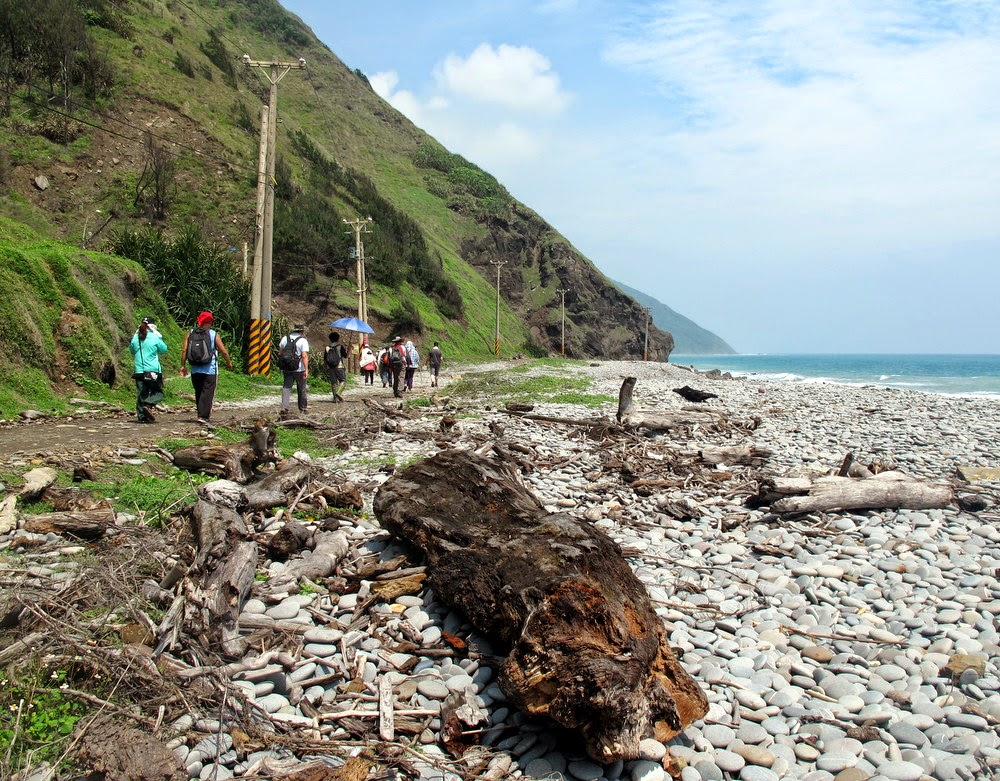
Two long stretches of the trail (which totals 4.5km) are right on the beach, which is why hikers must take note of tide times, and aren't allowed unless accompanied by guides.
No part of the beach is sandy and in many places it's littered with driftwood.
For more photos, see Part 2 of this post.

Wednesday, April 2, 2014

Taiwan's onion capital

It's onion-harvesting season in and around Checheng in Pingtung County (屏東縣車城鄉), a township many tourists pass through en route to Kenting National Park. In a few places, like the spot pictured, the smell of fresh onions is strong yet never overpowering. 

Friday, March 28, 2014

National Palace Museum to revise admission charges in July

Taipei's National Palace Museum (NPM) is adjusting admission charges effective July 1, but contrary to recent media reports, foreign citizens will not always be required to pay more than local Taiwanese.

As soon as I read that Taiwanese citizens would qualify for discounted tickets (NTD150 per adult, compared to NTD250 for standard admission), and that these would not be available to non-Taiwanese, I emailed the NPM for an explanation of the new policy. I believe 'double-pricing' of the kind common in a few countries reduces Taiwan's appeal as a tourist destination; I also think it's unfair to foreign nationals like myself who are resident in Taiwan and pay taxes here

According to the museum's reply, the new price structure won't discriminate against foreign citizens. Taiwanese will not be able to get discounted tickets simply by presenting their ID cards or passports. Foreign citizens, I was told 'may also benefit from the discounted prices, if they have a valid international school ID, or a youth travel card... foreign visitors who are under the age of 6, or have disabilities, may enter for free with one accompanying person.' However, the NPM staffer told me, there would still be certain discounts to encourage Taiwanese to visit, in accordance with government policy. How generous these will be remains to be seen.

Whether or not the new price structure is fair or not, NTD250 for admission to the NPM represents very good value for money for tourists interested in Chinese art. 

Thursday, March 27, 2014

Fresh Facts VIII: Taiwan's economy in 1939

By 1939, Taiwan was no longer producing as much camphor as it had some decades earlier, because of the invention of synthetic camphor, yet it was still the world’s no. 1 source of natural camphor. It was also the world’s third-largest producer of bananas and canned pineapples, no. 4 in global production of sweet potatoes and sugar, no. 6 for tea, no. 10 for rice and peanuts, and no. 13 for salt.

Nowadays, salt is no longer produced on a commercial basis (it's made the old way in a couple of places for educational/tourist reasons). Sugar production is minimal, and the quantity of tea grown has more than halved. However, Taiwan's teas (including those grown in the hills of Chiayi County, pictured here) are now regarded as among the very best in the world and command sky-high prices. Since the 1980s, bananas, pineapples and sweet potatoes have not been exported in significant quantities, although plenty are grown locally for domestic consumption.   

Wednesday, March 12, 2014

The 'biting cat' nettle

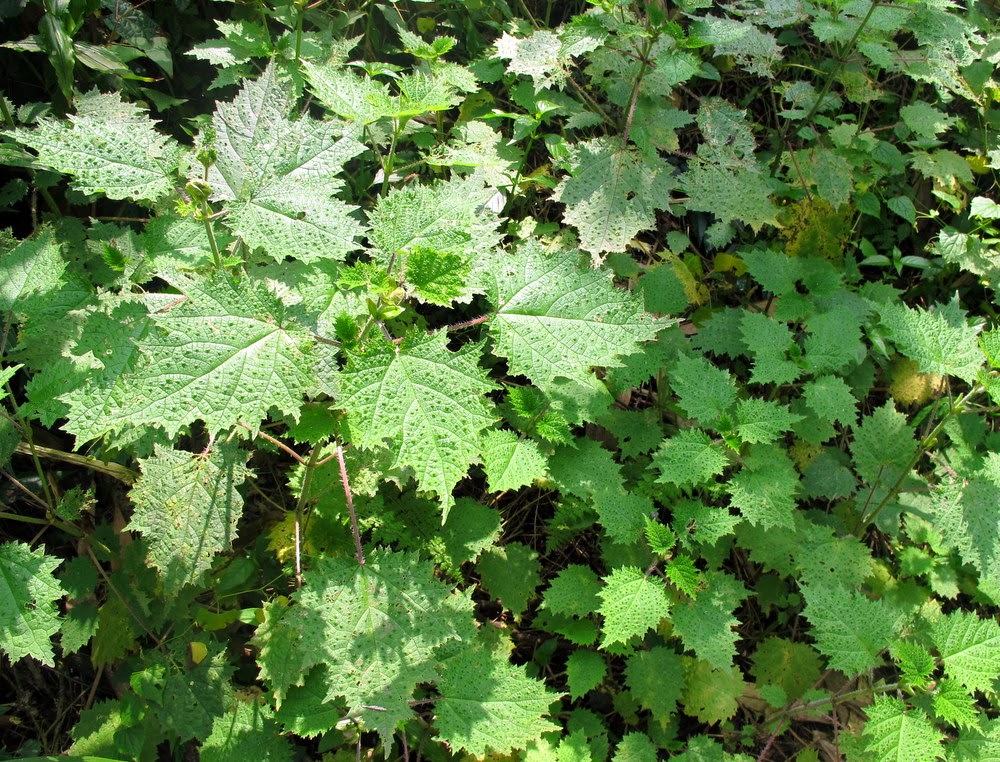
Hikers in Taiwan are often warned about this species of stinging nettle, which grows up to 1.2m tall. It's known to botanists as Urtica thunbergiana and to ordinary Taiwanese as 咬人貓 (yǎorénmao, 'biting people cat'). In addition to mid- and low-elevation mountain areas in Taiwan, it's also found in China and Japan. The stings may cause considerable discomfort for up to half a day but there's no need to seek medical attention if you brush against a plant. In two decades of frequent hiking, I've never suffered any stings.

Monday, March 3, 2014

Taiwan's best cycling roads

Michael Turton, an extremely knowledgeable American who's lived in Taiwan for more than 20 years, has written this very useful introduction to ten of the best cycling routes on the main island. I've been on nine of these roads (and may have been on the tenth - I'm not sure, it would have been about five years ago) and recommend all of them, even if you plan to drive or ride a motorcycle rather than pedal your way around Taiwan.

To mention just three of the ten... Highway 8, which links Hualien with Lishan via Taroko Gorge, involves a huge amount of climbing. Road 193 follows the boundary between the southern plains of Pingtung County and the rugged uplands near Maolin and Sandimen; there are some historical sights, too, such as Wanjin Basilica. Road 159A is an excellent approach to the Alishan area; exploring it one time by motorcycle, I went up a side road which was very promising until I reached the rockslide pictured above.

The wonderful thing about cycling, of course, is it's so easy to stop anywhere you find something of interest - whether it's piles of discarded oyster shells, like these I came across in Dongshi, Chiayi County - a temple or even an abandoned haunted mansion.