A week ago in Taipei I had time to kill before meeting a friend for dinner, so for the first time I explored Taipei City Hakka Cultural Park (臺北市客家文化主題公園), a short walk from Taipower Building MRT Station.
It's not a huge green space - just 4.03 hectares - but it is beautifully laid out and maintained. There's a farming demonstration area where rice is grown, a waterwheel, a number of pavilions where you can shelter from the sun or the rain, and a walkway/bikeway that goes over the levee to link with the cycle trails along the Danshui River. There are replicas of the tobacco-curing barns which still dot Meinong in Kaohsiung, and of the oblation furnaces in which Hakka people used to ritually burn any paper bearing written words.
The photo above comes from the park's thorough and bilingual website. Right next to the park you'll find the Taipei City Hakka Music and Theatre Centre, and the Hakka Cultural Centre.
Thursday, June 5, 2014
Tuesday, May 20, 2014
Egrets on the coast
Egrets cluster on a fishing vessel at Kezailiao Harbour (蚵仔寮漁港), Kaohsiung. The port here is pretty small but attracts a lot of visitors on weekends. Some buy superfresh seafood which they take home and cook, others enjoy meals or snacks at the adjacent eateries. For some more photos and details how to get to Kezailiao by public transport, see this blogger's writeup on the place.
Labels:
coast,
food,
Kaohsiung,
things that aren't in the guidebook
Wednesday, May 7, 2014
Oyster omelettes in Huayuan Night Market
Oyster omelettes are one of Taiwan's most popular street snacks, and Tainan's Huayuan Night Market (aka Flowers Night Market, 花園夜市), where these omelettes were being prepared, is one of south Taiwan's most-crowded night markets. In fact, it's usually so jammed with people - and not so near the city centre - that I haven't put it in my guidebook.
If you want to make your own oyster omelettes, here's a recipe.
Labels:
food,
Tainan,
things that aren't in the guidebook
Sunday, April 13, 2014
East Rift Valley
Also known as the Huatung Valley (花東縱谷), because it includes large parts of Hualien and Taitung counties, the East Rift Valley is a mainly agricultural region in Taiwan's thinly-populated east. The weather is often cloudy, and unlike Taiwan's west (and southwest in particular), the wet and dry seasons aren't pronounced.
There isn't much traffic and some of the valley's most attractive routes, such as Road 193, are quite narrow, so a motorcycle is the ideal vehicle for exploring. Here are the wheels I used last October, parked near Luoshan Waterfall (羅山瀑布). The waterfall is just visible in the background. The sign to the right of the motorcycle asks Buddhists not to release fish, turtles and other creatures into the pond. This tradition, known as 'mercy release', causes environmental problems beyond the suffering and premature death of the animals set free
On this trip I made it to one place I'd never been before: Taiyuan Hidden Valley (pictured above). It's very pretty, but tourists are told to not feed the slightly aggressive macaque population; at the time of my visit the local government had stationed a worker by the bridge specifically to educate outsiders that feeding encouraged bad behavior and could make the animals sick.
For photos taken during a train journey through the East Rift Valley, go here.
Labels:
ecotourism,
environment,
getting around,
Hualien,
Taitung
Sunday, April 6, 2014
Alangyi Ancient Trail, Part 2
It's hot going on the Alangyi Ancient Trail (click here for Part 1 of this post). However, in the greener stretches (first two photos) there are a few spots where you can pause in the shade, and listen as the guide points out indigenous fauna such as the screwpine in the lower left corner of the second photo.
On the beach we found a dead green loggerhead turtle (shown above). Then a very steep section of trail brought us to a vantage point with shade.
The end in sight! Hikers make their way down from the highest stretch of trail to the beach for a sunblasted march to the finish, just south of the village of Nantian (南田) in Taitung County. The hike took us about three hours, not including a stop for lunch - a bit quicker than average, according to our guide.
Labels:
coast,
environment,
hiking,
Pingtung,
Taitung,
things that aren't in the guidebook
Thursday, April 3, 2014
Alangyi Ancient Trail, Part 1
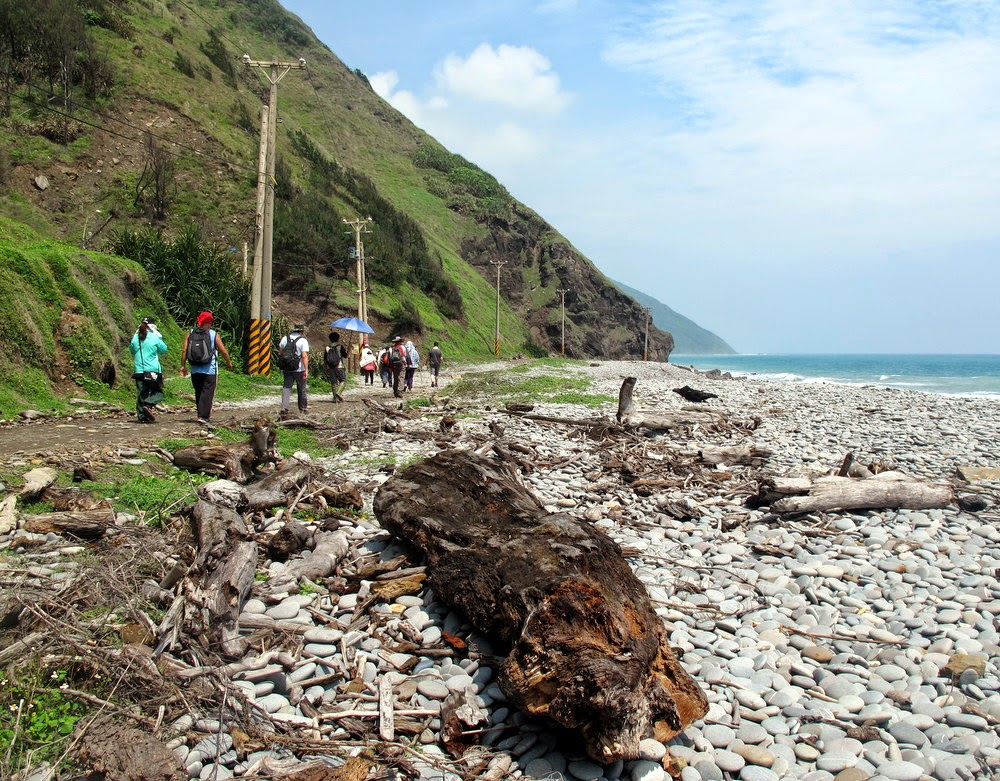
When the government announced plans to extend Highway 26 through this section of Taiwan's Pacific Coast (the project has since been cancelled), the public suddenly became aware of the Alangyi Ancient Trail (阿朗壹古道). This beachside track has since become a very popular hike, and the road-building project has been shelved. A quota of 300 people per day is imposed and permits (which must be obtained in advance at a cost of NTD150 per person) are carefully checked. We hiked from the southern end, near Xuhai (旭海) in Pingtung County. The first stretch of trail is a regular if narrow road from a small fishing harbor:
No part of the beach is sandy and in many places it's littered with driftwood.
For more photos, see Part 2 of this post.
Labels:
coast,
environment,
hiking,
Pingtung,
Taitung,
things that aren't in the guidebook
Wednesday, April 2, 2014
Taiwan's onion capital
It's onion-harvesting season in and around Checheng in Pingtung County (屏東縣車城鄉), a township many tourists pass through en route to Kenting National Park. In a few places, like the spot pictured, the smell of fresh onions is strong yet never overpowering.
Subscribe to:
Posts (Atom)