Over the past few years, several of Taiwan's museums, among them the Gold Ecological Park and Fort San Domingo, have scrapped admission charges. Visitors wanting to see the National Palace Museum's (NPM) unbeatable collection of Chinese antiques and art works still need to pay for admission. In fact, the normal ticket price has in the past decade risen faster than the rate of inflation, from NT$100 per person in 2001 to NT$160 now. However, there's good news fortourists: The museum recently adjusted its admissions policy in order to better manage the throngs of sightseers it receives.
Visitor numbers grew from 2.24 million in 2008 to 3.44 million last year, according to the museum's annual reports (click here to read the 2010 report). In a bid to encourage more people to visit during off-peak times, since the summer the museum has been offering half-price tickets to those entering between 4:30pm and 6:30pm.
Individuals who arrive in this period thus pay NT$80 each, while members of groups pay NT$50 per person. Students pay NT$40. Also, those who arrive in this period also qualify for discounts if that they dine in the museum's restaurant that evening.
The NPM extended its opening hours last year. It now opens its doors at 8:30 every morning, half an hour earlier than it used to. It stays open until 6:30 in the evening every day except Saturday, when it closes at 8:30pm.
Peak morning and afternoon times have been divided into four one-and-a-half hour slots, with no more than 2,800 people – independent visitors as well as members of tour groups – being allowed to enter in each period.
The 2010 report contains some interesting figures. To help meet running costs, which in 2010 totaled NT$1.015 billion, the NPM raises considerable sums from individual and corporate sponsors. In each of the past few years, around 100 people have paid NT$1,000 each to become Annual Friends of the NPM, and each year a dozen or two individuals donate NT$10,000 to become Lifetime Friends.
Corporate sponsorship amounted to NT$44.3m in 2010, up from NT$42.2m the previous year. The single largest donor was Phoenix TV, a Hong Kong-based Chinese-language broadcaster, which gave NT$25m in 2010 and NT$15m in 2009. Corporate supporters have also donated goods such as audio-visual equipment and services such as insurance for loaned artifacts.
The museum has developed other income streams that further reduce its dependence on ticket sales and government subsidies. In 2010, it sold NT$97.5m worth of publications. In the same year, companies authorized to make NPM-branded products sold NT$320.3m worth of wine, tableware, replica paintings and other items.
Tuesday, September 20, 2011

Wednesday, September 7, 2011
The southeastern coastline
 A favourite spot of mine a few kilometers south of Xuhai (旭海) on the southeast coast, very close to the boundary between Taitung and Pingtung counties.
Tuesday, September 6, 2011
Fresh facts III: Taiwan's Insects
Two things I learned in Taipei Zoo's excellent and very enjoyable Insectarium:
Relative to its land area, Taiwan has twice as many butterfly species as the Philippines, 17 times as many as Japan, and fifty times as many as the Chinese mainland.
Eighteen of the ROC's insect species are protected by conservation laws, including the Troides magellanus butterfly and Coptolabrus nankotaizanus, a ground beetle.
Thursday, August 18, 2011
Spelling issues
 The problem with romanisation, whatever version is used, is that the results sometimes resemble English words with negative connotations. There is a place in New Taipei City usually spelled Shiding (新北市石碇區), but sometimes - to the amusement of English speakers - written Shiting.
As far as I know, the inhabitants of the village featured in the photo above are hardworking and honest. The village's name, by the way, is pronounced something like HO BOR; it's in the northernmost part of Tainan. The sign would, of course, look better if 'village' had been spelled correctly.
Wednesday, August 10, 2011
Religious parade
 The celebrations a while back marking the renovation and reopening of Guangxing Temple (廣興廟) were the largest I've ever seen. This major shrine, which is dedicated to Shennong, is located in Tainan's Yongkang District (永康區).
 We were invited along because it's the "mother temple" of the Shennong shrine in my wife's home village, about 15km further inland. A team from the village carried their temple's icon and banner (on the left) through the neighborhood before finally arriving at the temple.
Considering they'd been up all night - marching from one supporter's house to another's, collecting donations at each stop - the team from my wife's village (below in orange shirts and yellow baseball caps) looked remarkably fresh.

 The various teams from the "daughter temples" had to wait their turn before moving in front of the "mother temple," where they performed in honor of the deity. Some had to wait well over an hour, but for photographers this was an excellent opportunity to get portraits of the pilgrims and members of the many different zhentou troupes, which included musicians, dancers, stilt-walkers and Ba Jia Jiang.
Friday, August 5, 2011
Birding in my backyard
Tainan has world-class winter birdwatching at Sicao (四草), now part of Taijiang National Park. It being the height of summer, it makes sense to look inland, so recently I spent two mornings birding in the foothills just east of my home in Xinhua (新化區), accompanied by a man who knows much more about avians than I do - Richard Foster of Barking Deer Adventures.
According to Richard, we spotted at least 18 species, including: White-rumped Munia; Black-naped Monarch; Black Drongo; Chinese Bulbul; Taiwan Barbet; Eastern Cattle Egret; Black-crowned Night Heron; Little and Intermediate egrets; Kingfisher; Taiwan Bamboo Partridge; Common Moorhen; and Eurasian Tree Sparrow. Also seen was a Grey-capped Pygmy Woodpecker or something very similar, and various swifts and swallows.
According to Richard, we spotted at least 18 species, including: White-rumped Munia; Black-naped Monarch; Black Drongo; Chinese Bulbul; Taiwan Barbet; Eastern Cattle Egret; Black-crowned Night Heron; Little and Intermediate egrets; Kingfisher; Taiwan Bamboo Partridge; Common Moorhen; and Eurasian Tree Sparrow. Also seen was a Grey-capped Pygmy Woodpecker or something very similar, and various swifts and swallows.
Tuesday, August 2, 2011
Little drummer boys
 Religious rituals in Taiwan are invariably accompanied by drums, bells, gongs, trumpet-like instruments and firecrackers. Some of the musicians are professionals but many are amateurs. A few, like these two boys I watched drum at Shoutian Temple a few months back, are not even ten years old.
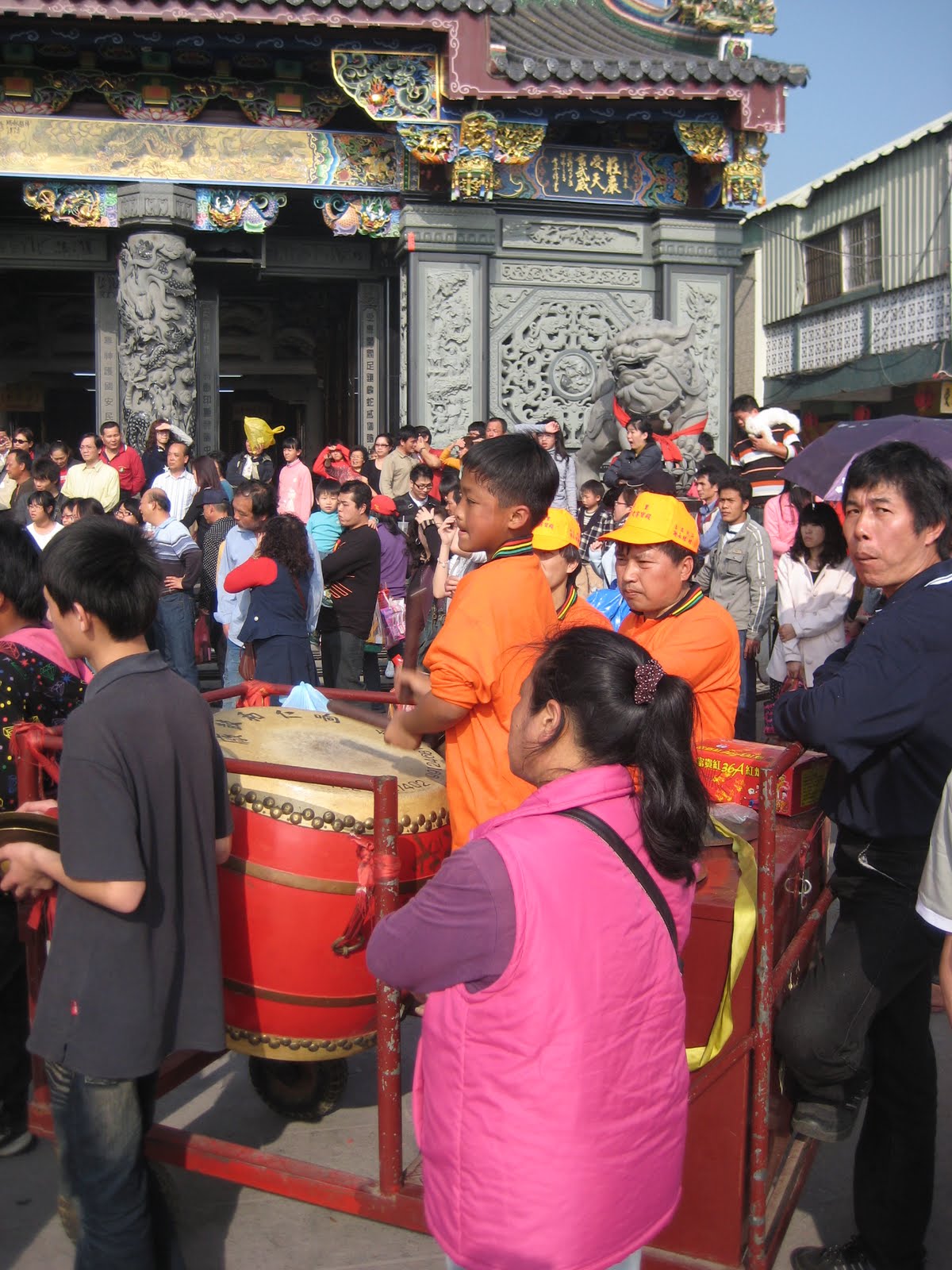 Hsieh Shih, founder of Ten Drum Art Percussion Group, started drumming at the age of three, taking part in rites at the Taoist temple his father owned.
Subscribe to:
Posts (Atom)
